Prove the teaching.
Not just the behaviour.
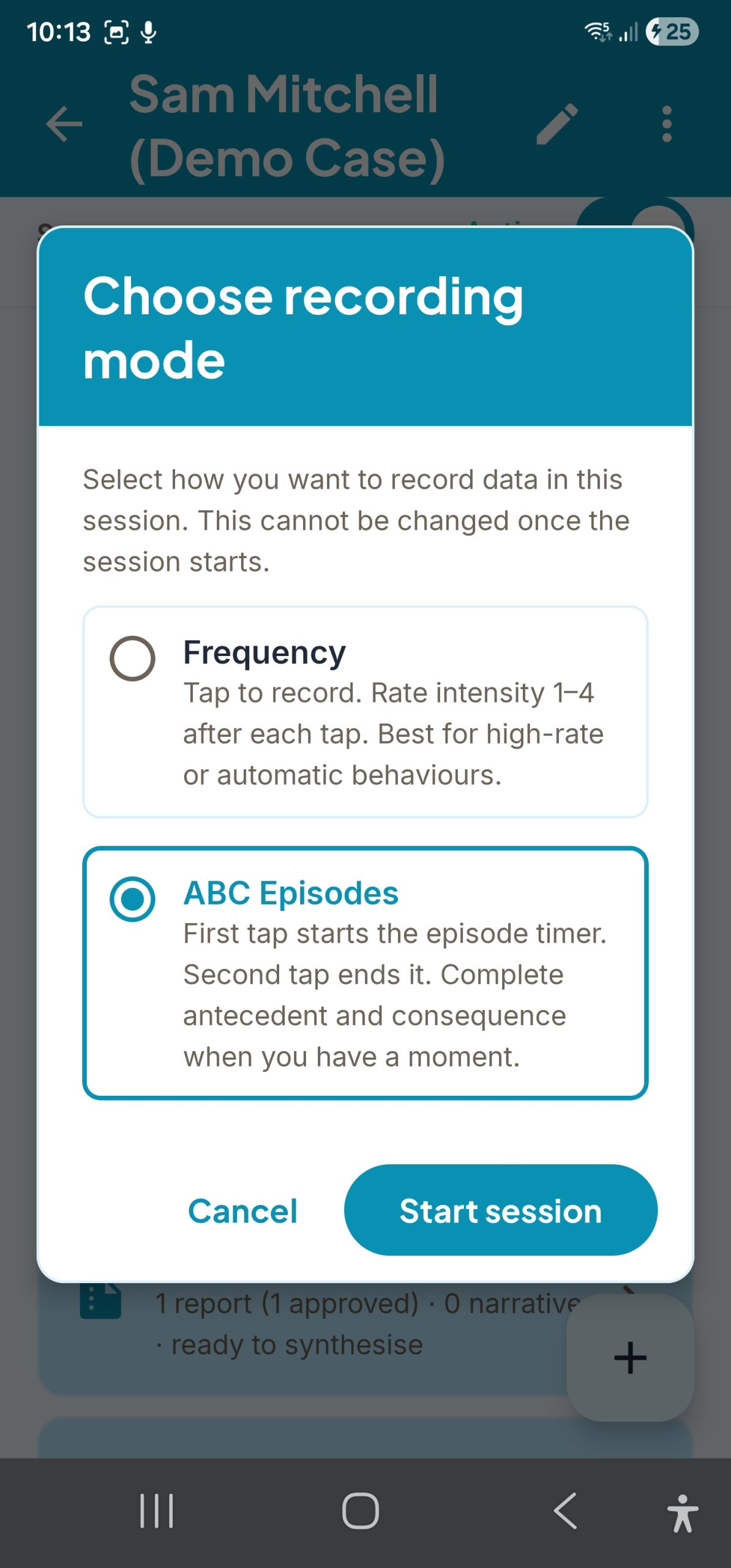
Most ABC tools prove behaviour happened. PBSTrack proves the teaching did. The Functionally Equivalent Replacement Behaviour — the skill you’re teaching to replace each behaviour of concern — sits at the centre of every session, so your data shows skill acquisition, not just incident counts. Recover 4–7 hours a week on documentation. Core data stays on your device.
Or see how a session works ↓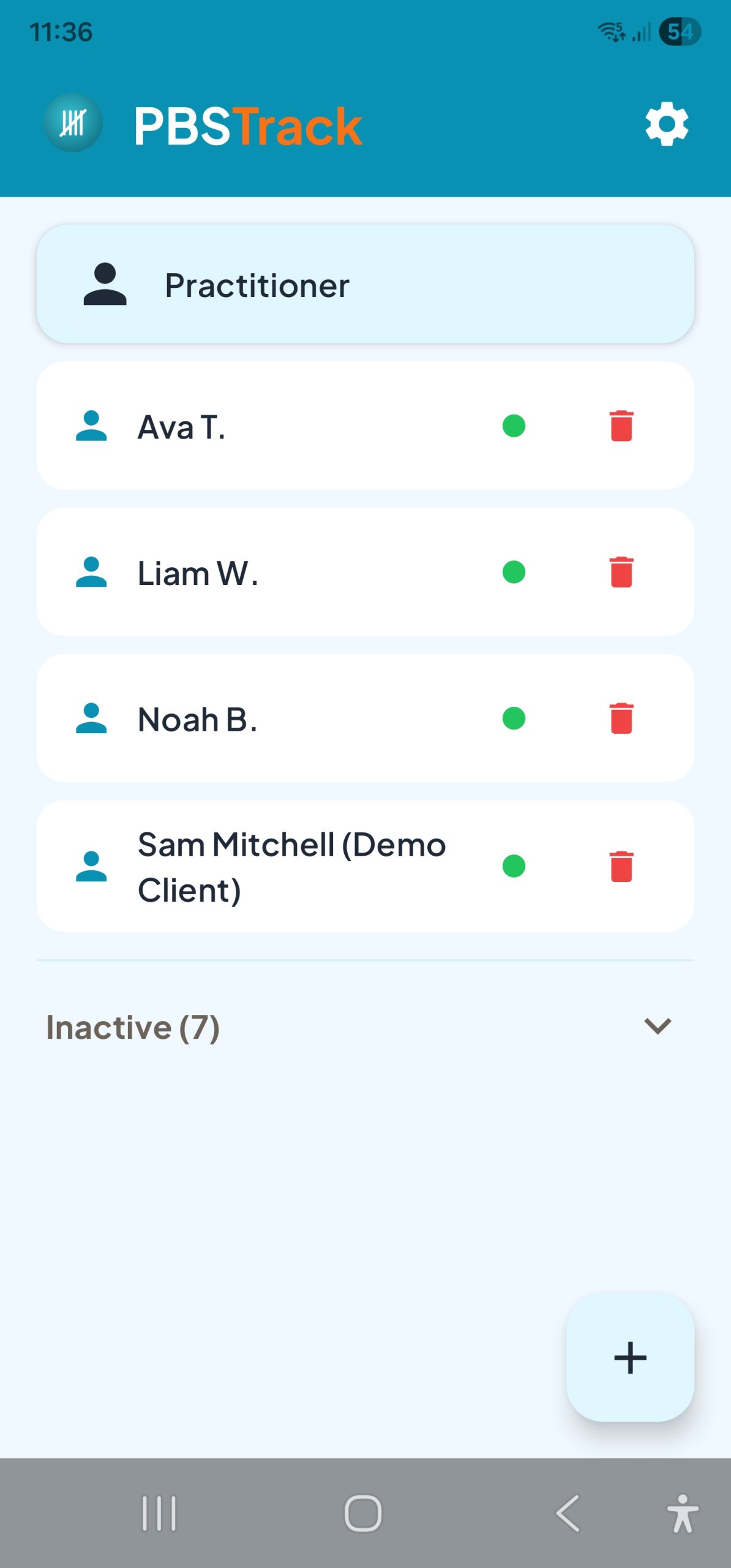

ABC tools were built to count.
You were trained to teach.
You didn’t qualify as a Behaviour Support Practitioner to be a data clerk. But every off-the-shelf ABC tool treats the work the same way: log the behaviour, code the antecedents, file the consequence. Hours of post-session entry produce a record of what went wrong — and almost nothing about what’s being taught to put it right.
Reviewers, families, and supervisors all ask the same question: is the support actually working? The data most tools produce can’t answer it. You can show how often a behaviour happened. You can’t show whether the replacement skill is being learned.
That gap is where a Behaviour Support Plan stops being a clinical instrument and starts being a compliance artefact. It’s also where 4–7 hours of your week disappear into spreadsheet wrangling no one reads.
Track the skill.
Not just the behaviour.
PBS isn’t behaviour suppression. It’s a deliberate stack: redesign the environment so the behaviour of concern is less likely, manage the Motivating Operations behind it, and teach the skill that achieves the same outcome safely. Every behaviour of concern works for the person — it gets attention, escapes a demand, secures a tangible, or regulates an internal state — so each layer addresses a different reason it works. The Functionally Equivalent Replacement Behaviour (FERB) is the skill that closes the loop: it makes the behaviour of concern unnecessary, because the person no longer needs it to get what they need.
Most ABC tools never see the FERB. PBSTrack treats it as the primary data stream.
How PBSTrack proves the teaching
-
1
Define the FERB at intake.
For every behaviour of concern, you specify the skill being taught — the request, the regulation strategy, the communication exchange, the tolerance response. The FERB sits in the client record as a clinical objective, not a comment-box afterthought.
-
2
Tag the FERB inline during recording.
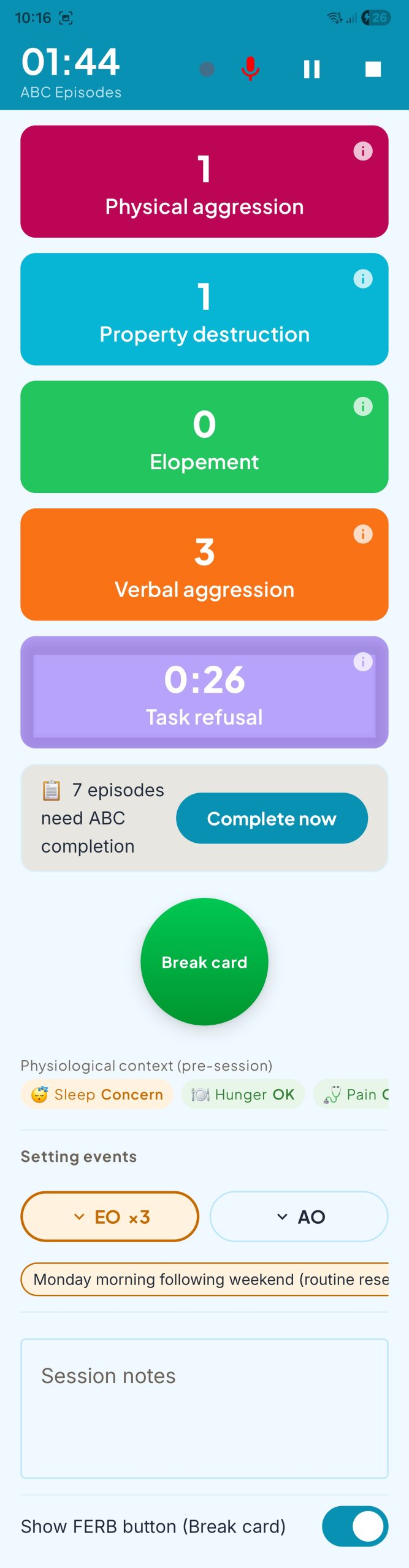
When you log an antecedent–behaviour–consequence event, one tap captures whether the FERB was used in that opportunity — instead of, before, or alongside the behaviour of concern. No double-entry. No retrospective coding.
-
3
Watch the FERB ratio shift in real time.
Each session produces a FERB ratio — the percentage of opportunities in which the replacement skill was used. Track it across sessions, weeks, and months. That ratio is your teaching evidence, quantified and time-stamped.
-
4
See what’s enabling — or blocking — the teaching.
The MO Flow Report correlates FERB performance with the Motivating Operations behind it: sleep, hunger, pain, medication, environment. When teaching breaks down on poor-sleep days, you know what to plan around — and you can show it.
-
5
Export it without re-coding.
FERB ratios, function hypotheses, and MO correlations flow straight into the progress note and the stakeholder report. Teaching evidence travels with the rest of the session — not as an afterthought.
This is the difference between an ABC log and a Behaviour Support Plan that’s actually working.
Built on PBS principles.
Not just a tally counter.
PBSTrack doesn’t just count events. It’s structured around the theoretical framework BSPs actually work in — FERB outcomes, function analysis, and Motivating Operations (the physiological and environmental states that shape behaviour) are baked into every session.
-
🔄
FERB tracking — unique in the market Track the Functionally Equivalent Replacement Behaviour (FERB) — the skill you’re teaching to replace the behaviour of concern — as a first-class data stream. FERB ratio per session shows whether teaching is working, giving you the outcome evidence NDIS and Child Safety reviewers expect.
-
🎯
Automated function hypothesis Every antecedent and consequence is pre-mapped to the four established behavioural functions — Escape, Attention, Tangible, and Automatic (including sensory-mediated behaviour) — plus an Other category. PBSTrack generates a function hypothesis from your data automatically — hypothesis-driven practice, without manual coding.
-
🧪
MO Flow — physiology linked to behaviour Motivating Operations (MO) are the physiological and environmental states — sleep, hunger, pain, medication — that make a behaviour more or less likely. Classify setting events as Establishing (EO, behaviour more likely) or Abolishing (AO, behaviour less likely). The MO Flow Report correlates pre-session state with session outcomes. Clinical intuition, made quantifiable.
-
📝
Progress notes + Word reports in seconds Generate a formatted progress note from any session in 1–2 minutes. Or export a full .docx stakeholder report — charts embedded, four clinical templates — ready when you leave the session.
-
🔒
Your data stays yours Core ABC session data lives on your device — no account, no sync required for baseline use. Optional Pro AI features are opt-in and practitioner-triggered per action. See our privacy policy for the full story on how your data is handled.